
Technology rarely moves in a straight line. It jumps, it pivots, and sometimes it reinvents itself overnight. As we look ahead to 2026, the pace of transformation is set to accelerate even faster. From automation and predictive intelligence to mobile app evolution and the future of software engineering, businesses will experience a shift that feels less like incremental improvement and more like a complete redesign of how digital systems operate.
Many organizations are already preparing for this shift by rethinking how they build products, scale platforms, and empower teams. The growing demand to Hire Dedicated Developers, partner with a modern Dot Net Development Company, or work with a trusted Machine Learning Development Company shows that enterprises are investing heavily in long-term digital capabilities.
2026 is shaping up to be the year when many of these investments become the foundation of entirely new business models.
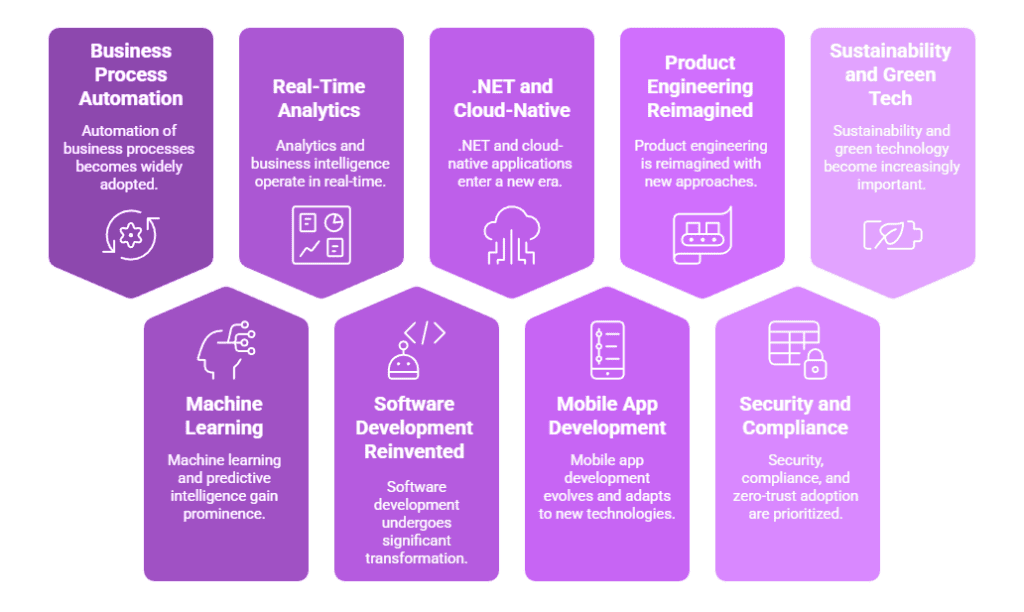
1) Business Process Automation Goes Mainstream
Business Process Automation (BPA) is no longer a tool used only by mature enterprises. By 2026, companies of every size will adopt automation to reduce operational overhead, speed up execution, and eliminate repetitive manual work.
This new wave of automation will combine rule-based workflows with intelligent decision-making. Platforms will independently route work, identify inefficiencies, and suggest improvements without waiting for human instructions.
Many organizations will invest in hyper-automation, where multiple automation technologies work together. These may include:
- AI-driven task routing and prioritization
- Automated document processing for banking, insurance, logistics
- Cross-cloud workflow orchestration
The ultimate result: business operations that are smoother, faster, and significantly more predictable.
2) The Rise of Machine Learning and Predictive Intelligence
Machine learning will become the strategic engine behind business decision-making. Instead of reacting to trends, companies will forecast them long before they emerge. A AI ML Development Company will play a key role in helping brands build customized predictive systems that continuously learn from new data.
Predictive analytics will power everything from marketing and sales to product design and supply chain forecasting. Rather than relying on rigid data models, businesses will lean on adaptive systems that understand user patterns, financial risks, and operational bottlenecks with far more accuracy.
As ML becomes accessible, the question will shift from “Should we adopt ML?” to “How fast can we scale it across the organization?”
3) Analytics & Business Intelligence Become Real-Time
For years, dashboards have helped leaders monitor performance. But in 2026, dashboards alone won’t be enough. Businesses will expect analytics systems that not only report data but interpret and act on it.
AI copilots embedded in BI platforms will:
- Summarize patterns across departments
- Highlight anomalies instantly
- Provide recommendations instead of static graphs
This shift toward real-time intelligence means decisions will no longer rely on scheduled reports. Instead, insights will come proactively, guiding teams before issues escalate.
Analytics and Business Intelligence will be less about “visuals” and more about “actionable interpretation.”
4) Software Development Reinvented
Modern software development will be shaped by global collaboration, AI-assisted engineering, and the rising need to Hire Dedicated Developers. As businesses expand rapidly, they need specialized talent that delivers consistent progress something dedicated teams excel at.
AI won’t replace developers, but it will become a powerful assistant. Code generation, documentation, unit testing, and refactoring will happen faster, allowing engineers to focus on architecture, creativity, and user experience.
Companies will form long-term partnerships with engineering teams capable of handling product strategy, cloud architecture, and continuous innovation. This creates stability in an era where product timelines continue to shrink.
5) The New Era of .NET and Cloud-Native Applications
The .NET ecosystem has evolved into a flexible, high-performance framework ideal for enterprise applications. By 2026, .NET’s cloud-native capabilities will be widely adopted for building distributed systems and scalable digital platforms.
Businesses will rely more heavily on specialized partners such as a Microsoft Solution Partners to modernize legacy stacks and streamline cloud migrations. The increasing demand to Hire Dedicated Dot Net Developers reflects how much enterprises value the stability, security, and speed of the ecosystem.
Whether it’s microservices, real-time systems, or cross-platform applications, .NET will continue positioning itself as one of the strongest development choices for enterprise-scale software.
6) Mobile App Development in 2026
Mobile development will shift from being “screen-first” to “intelligence-first.” Apps will act less like tools and more like responsive digital companions. On-device AI processing will allow apps to work faster while maintaining privacy since more data will remain on the device.
Several trends will shape the next era of mobile:
- AI-native mobile interfaces that personalize layouts and journeys
- Multi-experience applications spanning phones, watches, AR devices, and vehicles
- Near-instant app prototyping powered by GenAI
- Edge computing for lightning-fast offline functionality
Users will expect apps to anticipate needs, not merely respond to inputs. For businesses, mobile will become a strategic channel for delivering intelligent, always-on customer experiences.
7) Product Engineering Reimagined
Product engineering in 2026 will center around modularity, adaptability, and speed. Instead of long planning cycles, teams will rely on AI-driven prototypes that evolve quickly based on user feedback and real-world data.
GenAI will help engineering teams generate system architectures, suggest API structures, and analyze performance bottlenecks. Meanwhile, engineers will remain responsible for validating feasibility, ensuring security, and crafting scalable product foundations.
Product engineering teams will emphasize:
- Continuous iteration instead of one-time releases
- Cloud-native architecture from day one
- Reusable components that reduce development time
With innovation cycles shortening, agile product engineering will become one of the most valuable competitive advantages.
8) Security, Compliance & Zero-Trust Adoption
Businesses can no longer afford to treat security as an afterthought. Zero-trust frameworks where every user, device, and session must be verified will become a requirement instead of a recommendation.
In 2026, organizations will invest heavily in:
- Identity-based access controls
- Continuous verification
- Privacy-by-design product engineering
- AI-assisted threat detection
This shift is driven by regulatory pressures, customer expectations, and the increasing complexity of distributed cloud systems.
9) Sustainability & Green Tech
Environmental responsibility will be integrated into both infrastructure and development practices. Eco-friendly data centers, serverless computing, and energy-efficient coding will form the foundation of sustainable digital operations.
Companies will adopt greener engineering practices by monitoring carbon usage and optimizing processes. Teams will refactor outdated systems to use fewer resources while still delivering better performance.
Sustainability won’t be a marketing checkbox it will be a competitive advantage and a brand expectation.
What These Trends Mean for Businesses in 2026?
The core message is clear: transformation is no longer optional. The companies that adapt early, invest wisely, and collaborate with the right engineering partners will create long-lasting success.
Businesses that integrate automation, predictive intelligence, strong engineering talent, and mobile innovation will move faster, deliver better user experiences, and outperform slower competitors. Whether through dedicated teams, cloud-native modernization, or full-scale product engineering, the winners of 2026 will be those who choose to evolve today.
Conclusion
2026 represents a pivotal year in digital transformation. From AI-driven mobile apps to predictive analytics, product engineering evolution, and modern .NET development, the technology landscape is becoming more intelligent, more automated, and more user-centered. Companies choosing to Hire Dedicated Developers, partner with a Dot Net Development Company, or collaborate with a Machine Learning Development Company will be positioned to innovate confidently.
The future will belong to businesses that learn fast, adapt early, and embrace technology not as an accessory but as a strategic core.
FAQs
1) Which technologies will have the biggest impact in 2026?
AI-driven automation, predictive intelligence, mobile innovation, and cloud-native development will lead the next wave of transformation.
2) Why are companies choosing to Hire Dedicated Developers?
They offer consistency, specialized skills, and long-term technical ownership crucial for modern product lifecycles.
3) How will mobile app development change?
Apps will become AI-native, multi-experience, and capable of real-time personalization with on-device intelligence.
4) Why work with a Machine Learning Development Company?
They help build custom ML models, predictive systems, and intelligence layers tailored to business needs.
5) What makes .NET important for 2026?
Its performance, security, and cloud-native compatibility make it ideal for modernizing enterprise applications.